
History, notables, monuments worth the walk — and the well-sourced legend of Midnight Mary
Evergreen Cemetery sits on about 85 acres in New Haven’s West River neighborhood, at 769 Ella T. Grasso Boulevard. Founded in 1848 by some of the city’s most prominent citizens, it remains an active, non-sectarian burial ground managed by a nonprofit board. Roughly 85,000 people are interred here. It is larger and more varied than nearby Grove Street Cemetery (1797), and for investigators and local-history walkers it packs an unusual combination: solid nineteenth-century rural-cemetery landscape, a dense roster of documented notables, and one of Connecticut’s most durable urban legends — Midnight Mary.
This article separates the documented history of the place from the ghost stories that grew up around it. The history checks out against the cemetery’s own records, local reporting, and standard biographical sources. The legend is treated as folklore: long-lived, widely retold, and thin on primary evidence for its wildest claims.
Plan your visit
Address: 769 Ella T. Grasso Boulevard, New Haven, CT 06519 (also reachable from Winthrop Avenue along the eastern edge).
Office hours (typical): Monday–Friday 7:30 a.m.–4:00 p.m.; Saturday 8:00 a.m.–noon. Grounds access can vary — confirm current hours with the office before you go.
Phone: (203) 624-5505 · Web: evergreencem.org
Cost: Free to walk the grounds during open hours. The office can often provide a map of notables (including Midnight Mary) and help with grave locations. A smartphone burial-search tool is also available via the cemetery’s site.
Etiquette: This is a working cemetery, not a haunted attraction. Stay on paths, do not climb monuments or fences, leave nothing permanent on graves beyond ordinary flowers, and do not visit after hours or at midnight “for the curse.” After-hours entry is trespass. The legend is interesting enough in daylight.
History: why Evergreen exists
New Haven’s earliest dead went into the burial ground on the Green. By the early nineteenth century that ground was full; new interments there effectively stopped around 1821. Grove Street Cemetery, opened in 1797 as one of America’s first planned “city of the dead” burial grounds, absorbed much of the pressure — but by the 1840s New Haven needed more room for a growing industrial city.
Evergreen was laid out in 1848 in the rural-cemetery tradition then spreading across the United States (Mount Auburn in Cambridge had opened in 1831; Green-Wood in Brooklyn in 1838). Instead of a crowded churchyard grid, the ideal was a landscaped park of curving drives, trees, family plots, and sculptural monuments — a place for the living to walk as much as a place for the dead to rest. Evergreen’s board still presents it that way: a nonprofit, non-sectarian “haven of tranquility” rather than a commercial memorial park.
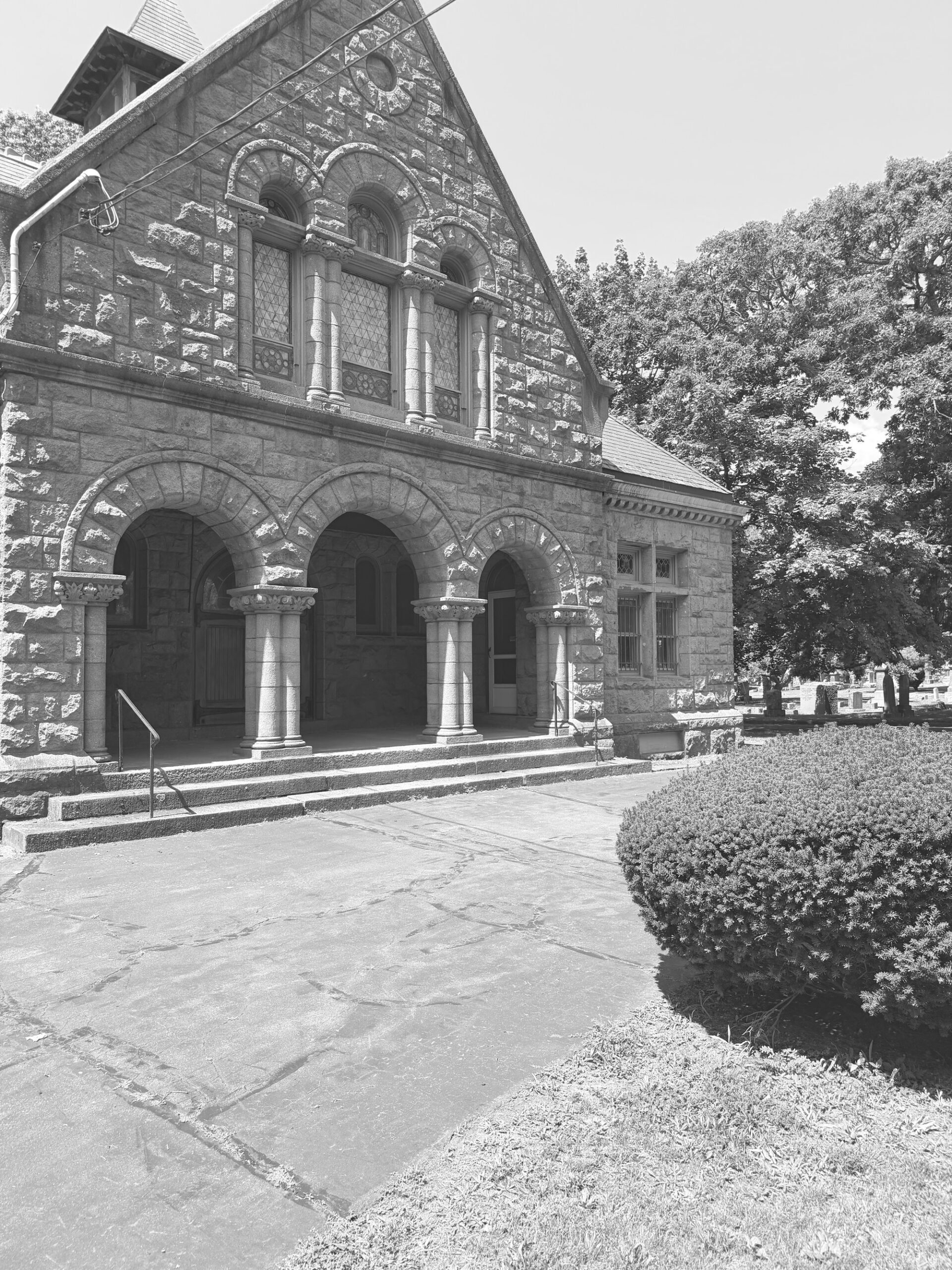
Major additions mark the cemetery’s own timeline. A stone memorial chapel was built in 1902 (once used for services; still one of the strongest visual anchors on the grounds). Connecticut’s second crematorium was added here in 1956. New administrative offices went up in 1999. Find a Grave and local features put the burial count near 85,000 across the full 85 acres — a denser cross-section of New Haven life than the older, more elite Grove Street roster.
Famous people buried at Evergreen
The office map of notables is the practical starting point. Among those documented in cemetery records, Wikipedia’s summary of the grounds, Daily Nutmeg’s local reporting, and standard biographies:
- Oliver Fisher Winchester (1810–1880) — New Haven industrialist who made the Winchester Repeating Arms Company a national name. Family plot on the grounds.
- Sarah Winchester (1839–1922) — Widow of William Wirt Winchester; better known nationally for the Winchester Mystery House in San Jose, California. She is buried in the family plot with her husband and infant daughter Annie. Atlas Obscura notes an eight-foot rough-hewn marker, a carved basin, a memorial bench, and a low curb outlining the plot. Directions often given: left at the crematorium near the entrance, follow the outer path; the plot sits on the right just past the first curve.
- Edward Bouchet (1852–1918) — First African American to earn a Ph.D. from an American university (Yale, physics, 1876) and among Yale’s earliest Black graduates. A major figure in American education history, often overlooked on tourist maps that only list industrialists and governors.
- Wilbur L. Cross (1862–1948) — Yale English professor and four-term governor of Connecticut (1931–1939). The Wilbur Cross Parkway carries his name.
- Hobart B. Bigelow (1834–1891) — Governor of Connecticut, 1881–1883.
- Bronisław Malinowski (1884–1942) — Foundational social anthropologist; died in New Haven while at Yale. His presence is a quiet irony for anyone standing at Midnight Mary’s stone thinking about how legends function in a community.
- William Chester Minor (1834–1920) — Physician and major volunteer contributor to the Oxford English Dictionary; his complicated life (including years in asylum custody after a homicide in London) is documented in Winchester’s The Professor and the Madman and OED historiography.
- Ilya Tolstoy (1866–1933) — Writer; son of Leo Tolstoy.
- Louis Lassen (d. 1935) — Founder of Louis’ Lunch, the New Haven institution long associated with the early hamburger. Local sources place him at Evergreen.
- Edwin S. Greeley (1832–1920) — Civil War general and later industrialist.
- John Haberle (1856–1933) — Trompe-l’œil painter.
- George Weiss (1894–1972) — Baseball Hall of Fame executive.
- Teresa Wright (1918–2005) — Academy Award–winning actress; remains donated to Yale School of Medicine and associated with a small mass grave in Section 14 (per published cemetery notes).
Find a Grave’s cemetery page adds that Evergreen holds multiple Connecticut governors and lieutenant governors, plus one Commonwealth War Graves Commission burial (a World War I Royal Flying Corps cadet). The point for a field visit is not to tick every name — it is that this ground is not a single “haunted cemetery” story. It is New Haven’s civic memory in granite.
Monuments you should actually go see
Beyond individual famous graves, Evergreen rewards a slow walk for the landscape of mourning common to rural cemeteries of its era:
- The 1902 memorial chapel — Rough-faced granite, triple-arched porch, Romanesque detailing. Even when not open for services, it is the architectural centerpiece of the grounds and a natural orientation point for photography and wayfinding.
- The Winchester family plot — Worth finding even if you only know Sarah from California tourism. It anchors the New Haven half of a story usually told only on the West Coast.
- Edward Bouchet’s grave — If you only make one “history first” stop, make it this one. The scientific and educational significance is national, not merely local.
- Victorian figurative sculpture — Mourning figures, angels, and obelisks are thick on the older avenues. New England Folklore’s visit notes (and any daytime walk will confirm) clusters of obelisks and weathered female figures that read as a outdoor museum of late-Victorian funerary art.
- Mary E. Hart / “Midnight Mary” — Pink granite block on Evergreen Avenue near the Winthrop Avenue fence line (Plot 50, Grave 4 on commonly cited maps). The cemetery has long acknowledged the legend; older write-ups even note her marked on maps as a “resident ghost.” The stone was reportedly refinished in the early 1970s when management thought it looked worn. Atlas Obscura’s field directions: enter, take first available left; continue to the fence paralleling Winthrop; turn right; pass the old locked Winthrop gate; the stone is on the right near markers 50/51.
Bring water, decent shoes, and a phone with the burial search or a paper map from the office. The acreage is large enough to get pleasantly lost.
The ghost story: Midnight Mary
Mary E. Hart (December 16, 1824 – October 15, 1872) is Evergreen’s famous dead. Almost nothing reliable is known about her life. Yale’s New Haven Inscriptions project summarizes the honest baseline: “nothing actually is known about Mary or her death” beyond what the stone says — later tradition makes her a seamstress from the Winthrop Street neighborhood just east of the cemetery. What made her immortal is the epitaph.
THE PEOPLE SHALL BE TROUBLED AT MIDNIGHT AND PASS AWAY.
At high noon, just from, and about to renew
her daily work, in her full strength of
body and mind,
Mary E. Hart,
having fallen prostrate,
remained unconscious, until she died at midnight.
October 15, 1872.
Born December 16, 1824.
The opening line is drawn from Job 34:20 (King James tradition): a statement that death comes for high and low alike. On a pink granite face in all caps, stripped of biblical context, it reads like a curse. That misreading is the engine of the legend.
What the legend claims
Versions differ in detail but share a core plot, retold in David E. Philips’s Legendary Connecticut, Atlas Obscura, Roadside America visitor tips, New England Folklore, and generations of local oral tradition:
- Mary collapsed at midday on October 15, 1872, and remained unconscious until she was pronounced dead at midnight.
- She was buried quickly — in some tellings the same night.
- A relative (sister or aunt, depending on the version) dreamed that Mary was still alive and screaming in the coffin.
- The family ordered an exhumation and found evidence she had revived underground: bloody fingers, torn nails, a face frozen in panic — the classic “buried alive” tableau of nineteenth-century nightmare.
- The stone’s Job quotation is then reinterpreted as Mary’s curse: anyone who desecrates the grave, or who remains in the cemetery after midnight, will die soon after — by fence impalement, traffic accident, throat wound, disappearance, or sheer terror.
Campus and city lore adds set pieces: students found dead on the stone at dawn; sailors impaled climbing the iron fence; a man whose coat caught on a bush and who died of fright thinking Mary had grabbed him. New England Folklore collects several of these variants and notes the shared ending — people end up dead — which is exactly how a cautionary urban legend trains teenagers not to dare each other into locked graveyards at night.
What the evidence supports
Separate the layers carefully:
- Documented: A Mary E. Hart with those birth and death dates is buried at Evergreen under that inscription. The Job line and the midday-to-midnight collapse narrative are on the stone itself. The legend is old enough and consistent enough to count as genuine local folklore, not a recent internet invention. Cemetery management has long been aware of the fame; general manager Dale Fiore has told Daily Nutmeg he once answered a night alarm and left the grounds before midnight more quickly than dignity might prefer — a good story told with humor, not a paranormal claim.
- Not documented: There is no known contemporary newspaper account confirming the exhumation, the bloody fingers, or a legal finding of premature burial. Atlas Obscura states plainly that “there’s no documentation that this ever happened.” Yale’s inscription notes treat the buried-alive narrative as legend layered onto an opaque death, not as established fact. Nineteenth-century America was full of premature-burial panics (safety coffins, waiting mortuaries, Poe’s fiction); Mary’s stone was perfect fuel whether or not any exhumation occurred.
- Folklore function: The “curse” stories police after-hours trespass and grave vandalism. That does not make them true; it explains why they persist. For field investigators, the honest product is: a real grave, a striking primary text on the monument, and a multi-generational oral tradition — not a verified poltergeist case file.
How to investigate it (if you must)
If you document the site, do it the Ghosthound way:
- Photograph the full inscription (front and any side text) in daylight; transcription errors feed bad secondary sources.
- Note GPS, section markers (50/51), and the relationship to the Winthrop fence — location data ages better than “back left somewhere.”
- Record ambient conditions if you collect EVP or meter readings, but do not treat EMF spikes near iron fences and road traffic as evidence of Mary Hart.
- Interview living tradition (tour guides, longtime neighbors, cemetery staff) separately from claims about 1872. Contemporary feeling is data about the legend’s life; it is not data about Mary’s death.
- Leave offerings only if the cemetery permits them, and never damage the stone. The 1970s refinishing history is a reminder that the monument is cared for as heritage, not as a prop.
Other haunt notes
Midnight Mary dominates the paranormal reputation, but visitors and local writers sometimes describe a general unease after dark, cold spots, and the ordinary cemetery atmosphere of crows, shadows, and monumental sculpture — especially the damaged mourning figures. Those reports are subjective and not tied to a second named entity with Mary’s cultural footprint. Grove Street and the Crypt at Center Church on the Green carry their own New Haven dead-lore; Evergreen’s distinct contribution is Mary’s text-driven legend plus the Winchester and Bouchet historical weight.
Field notes
Evergreen is one of the better “history first” cemetery visits in Connecticut. You can spend two hours only on documented lives — Winchester industry, Bouchet’s doctorate, Malinowski’s anthropology, a governor’s parkway namesake — and still have a full day. The ghost story is a genuine, well-attested piece of New Haven folklore built on a real epitaph; it does not need invented “proof” of premature burial to be worth recording. Walk it open hours, get the map, stand at Plot 50 in daylight, read Job 34:20 the way the stonecutter likely meant it, and then read the campus dare-legend the way folklorists mean that. Both readings belong in the file. Only one of them is a death record.
Sources
- Evergreen Cemetery & Crematory (official): history, hours, burial search — evergreencem.org
- Find a Grave, Cemetery ID 103328 — cemetery description, burial counts, notable links
- Wikipedia, “Evergreen Cemetery (New Haven, Connecticut)” — notables list with secondary citations
- Cara McDonough, “Lives and Times” / “The Rest is Grave-y,” Daily Nutmeg (2013; cemetery history, notables, Fiore anecdote)
- Yale CampusPress, “NHI 1: Midnight Mary (Evergreen Cemetery)” (2024) — full inscription, plot citation, legend vs. evidence
- Atlas Obscura — “Grave of Midnight Mary”; “Grave of Sarah Winchester” (location notes; buried-alive documentation caveat)
- Roadside America — visitor tips for Midnight Mary’s grave
- New England Folklore (Peter Muise), “The Ghost of Midnight Mary” (2015) — variant curse tales; Malinowski adjacency
- David E. Philips, Legendary Connecticut: Traditional Tales from the Nutmeg State (Curbstone) — standard secondary compilation of the Mary Hart legend
- J.W. Ocker, The New England Grimpendium — field-oriented retellings of Mary and Sarah Winchester graves