
Live space-weather conditions from NOAA’s Space Weather Prediction Center — not third-party badge sites.
Ghost hunters have long watched solar and geomagnetic activity because strong geomagnetic storms can disturb the Earth’s magnetic field and add noise to EMF meters, radio, and other instruments. Use the official sources below. Do not rely on old amateur “status badge” sites such as n3kl.org — that service is defunct / unsafe and is no longer linked from Ghosthound.
Current conditions (NOAA SWPC)
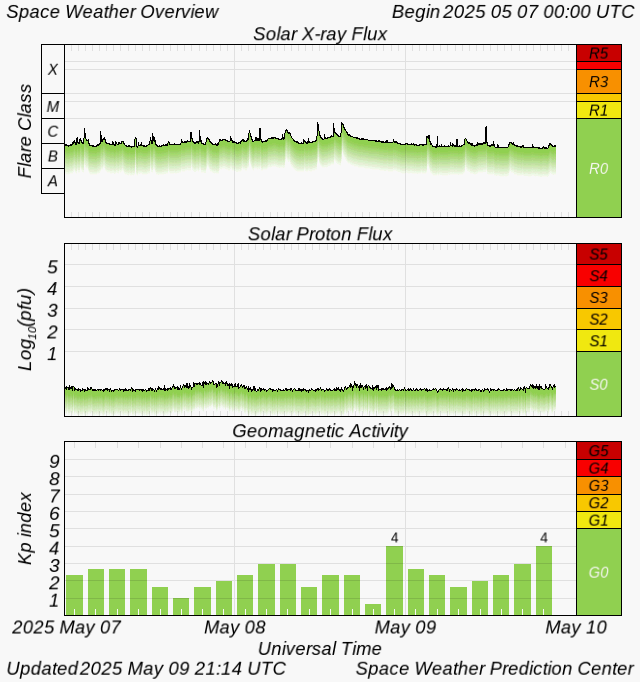
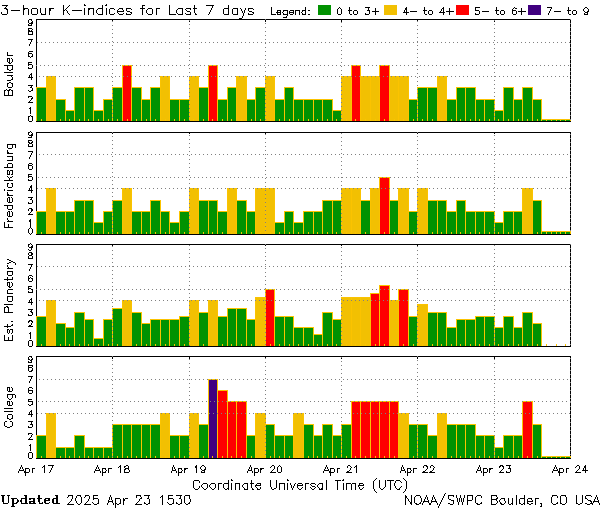
These images and products are served directly by the U.S. National Oceanic and Atmospheric Administration’s Space Weather Prediction Center. They refresh on NOAA’s schedule; reload the page for the latest frame.
Space weather overview (solar radiation, geomagnetic, radio blackout scales)
Estimated planetary K-index (geomagnetic activity; higher Kp ≈ more disturbed field)
[gh_space_weather]
How to read the scales
- R (Radio blackouts) — Solar X-ray flares. R1–R5. Affects HF radio; not the same as a geomagnetic storm.
- S (Solar radiation storms) — Energetic particles. S1–S5. Important for satellites and aviation polar routes.
- G (Geomagnetic storms) — Disturbance of Earth’s magnetic field. G1 (minor) through G5 (extreme). This is the scale most relevant to ground-level magnetometers and “noisy” investigation nights.
- Kp index — 0–9 scale summarizing geomagnetic activity over 3-hour periods. Roughly: Kp 0–2 quiet, 3–4 unsettled/active, 5 = G1, 6 = G2, and so on up to Kp 9 = G5.
Full scale definitions: NOAA Space Weather Scales.
Official links (bookmark these)
- NOAA / NWS Space Weather Prediction Center — homepage dashboard
- GOES X-ray flux — solar flare monitoring
- 3-day forecast — text product (geomagnetic + solar)
- Aurora 30-minute forecast
- Space weather enthusiasts dashboard
Field notes for investigators
- Log date/time (UTC and local), Kp or G-scale, and your instrument readings. Correlation is interesting; it is not proof of a haunting.
- A G1 night can raise baseline EMF and radio noise. Compare “active” and “quiet” nights at the same site before drawing conclusions.
- Prefer NOAA products over random badge graphics or abandoned hobby sites. If an embed breaks, the SWPC homepage still has the data.